
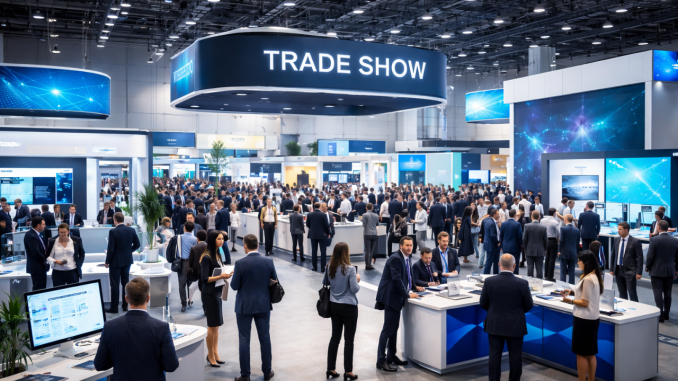
Geopolitical instability, rising protectionism, and changing trade routes are fundamentally rewriting the playbook for the global exhibition and trade show industry. Historically driven by globalization and market efficiency, trade shows are rapidly pivoting to address economic fragmentation, localized supply chains, and strict national regulations.
This macro-political shift alters where trade shows are hosted, how event booths are built, and which industries dominate convention centers globally.
As traditional Western hubs face mounting visa barriers, political polarization, and high operational costs, new epicenters of business activity are surging.
Backed by heavy destination-marketing incentives, the Middle East and Africa are projected to post a strong 6.42% CAGR through 2031. Events are also rapidly shifting to the Asia-Pacific region to leverage resilient intraregional trade alliances.
Corporate planners are increasingly choosing host nations based on political neutrality, travel accessibility, and operational continuity over sheer brand presence.
Major international exhibition organizers are launching smaller, hyper-localized versions of their legacy shows to capture markets isolated by modern trade restrictions. Rising global protectionism and aggressive tariff policies drastically impact the physical and financial structures of trade shows. Import Tariffs & Duties inflates the costs of imported AV gear, advanced electronics, staging assets, and marketing materials. Supply chain and port delays dictates strict timelines, forcing exhibitors to book freight months earlier or switch to local builders. “Buy Local” sentiments boosts domestic suppliers over international contractors, keeping event spends inside regional borders.
Unpredictable maritime shipping rates, chokepoint disruptions, and carbon-border adjustments have completely altered physical booth logistics
To sidestep the high risks and costs of cross-border transport, exhibitors are universally adopting modular, multi-show booth designs. Booths are now routinely fabricated locally using modular components that can be rented, adapted, and stored in regional hubs rather than shipped globally. Simultaneously, strict sustainability mandates across economic blocs mean eco-friendly materials are no longer optional—they are a critical risk-mitigation tool against shifting regulatory updates. To ensure continuity against border closures, regional safety concerns, and sudden travel bans, the events industry relies heavily on technology to safeguard its global reach. Hybrid and virtual event formats are logging a sustained 6.55% CAGR as companies build digital alternatives to hedge against international travel risks. Rather than dealing with heavy customs procedures to transport large physical prototypes, exhibitors use AR/VR activations and 3D digital walkthroughs to display complex machinery. With physical foot traffic highly volatile due to global disruptions, exhibitors are heavily leveraging AI-powered analytics to ruthlessly screen, track, and score lead quality in real time.
The industries commanding the largest footprints on convention center floors have fundamentally shifted. While consumer goods face geopolitical turbulence, sectors tied directly to economic security and self-reliance are seeing unprecedented trade show growth. According to data tracked by the International Exhibition Statistics, shows focusing on IT and Telecom hold the largest revenue share, running alongside massive floor expansions in Defense, Aerospace Manufacturing, Renewable Energy, and Cybersecurity. When national policies pivot toward nearshoring and supply chain resilience, corporate budgets adjust—making trade shows the premier arena to showcase structural independence.
The World Trade Organization, among others, is fighting to maintain a rules-based order, but escalating trade wars and economic nationalism increasingly challenge the principles of open markets. Meanwhile, the intersection of national security and economic policy is fundamentally altering how nations and multinationals approach their international partnerships and critical supply chains.
This turbulent environment has created both opportunities and vulnerabilities for major and emerging economies. Major Asian markets are positioning themselves to leverage their distinct advantages to accelerate their economic growth. Meanwhile, European nations are grappling with national and supranational demands, while seeking to balance competitiveness and resilience for their increasingly restive populations. The implications of this strategic realignment extend far beyond traditional trade metrics, too. Supply chains have become instruments of national security policy, technological advancement is driving new forms of economic competition, and the fight for critical materials will have a major effect on global climate commitments. As businesses and governments navigate this uncertain landscape, the question remains whether any stakeholder truly benefits from the current trajectory of global trade or whether divides and imbalances will become more entrenched to the detriment of the global economy.
The India-UK CETA aims to double bilateral goods-and-services trade from US$56 billion in FY2024–25 to US$112bn by 2030.
India has opened 89.5% of its tariff lines, covering 91% of the UK’s exports to India. This includes a phased reduction of whisky tariffs from 150% to 40%.
For the UK, the deal will provide a larger boost to its GDP, than other post-Brexit FTAs. In the long run, the CETA is expected to increase India’s GDP by £5.1bn a year, and the UK’s GDP by £4.8bn a year.
The international reach of German trade fairs is one of their defining strengths and key competitive advantages. At the same time, significant international demand is being shaped by geopolitical uncertainty, the need for infrastructure investment and domestic factors that are slowing economic growth. Modern visa procedures, robust infrastructure and tailored trade fair support programmes are crucial to the competitiveness of Germany, the world’s leading trade fair destination. This is one of eight trends analysed by the Association of the German Trade Fair Industry (AUMA) in its recently published annual report. With “AUMA Trends 2026/2027”, the association highlights the developments currently shaping the sector and the challenges and opportunities that will define the future.
Jörn Holtmeier, Managing Director of AUMA, the Association of the German Trade Fair Industry: “The German trade fair industry is proving resilient in these volatile times. It combines economic stability with innovative strength, global reach with strong regional roots, and face-to-face encounters with digital progress. Its ability to drive transformation while maintaining its role as a central platform for business, knowledge transfer and personal interaction is what makes the German trade fair industry resilient.”
Today, exhibition performance is defined not by visitor numbers alone, but by the quality of participation. Qualified buyers create meaningful business opportunities, attracting stronger exhibitors and reinforcing a virtuous cycle across the entire exhibition ecosystem.
Recognising this shift, the Thailand Convention & Exhibition Bureau (TCEB) has recently launched the Visitor Power Up initiative. The programme supports organized international buyer delegations through associations, chambers of commerce, and federations at selected B2B exhibitions in 2026. With a strategic focus on the ASEAN+6 markets, it promotes high-value participation through facilitated networking and curated business matching, ensuring more targeted and effective buyer–exhibitor engagement.
For participating associations and their members, the main value lies in connecting with qualified buyers, strengthening sourcing outcomes, and accelerating deal-making in a focused exhibition environment. Associations interested in bringing buyer delegations to Thailand are encouraged to contact Thai exhibition organizers to learn more about the special privileges available under the programme.
Over the past two months, we have continued to see a mixed global picture: economic uncertainty alongside resilience, rapid developments in technology & AI, changing travel patterns and businesses continuing to balance growth ambitions with cost pressures.
For our industry, this reinforces something we already know well — exhibitions do not operate in isolation. We are closely connected to business confidence, international travel, investment & the movement of people and ideas, says Panittha Buri, UFI President.
Based on a total economic impact of €392.8 ($443.6) billion and a global total of 44.27 million sqm of capacity (as reported in the UFI World Map of Exhibition Venues 2025), total output per sqm of capacity amounted to approximately €8,900 ($10,000) in 2025.
In 2025, exhibitions sold more than 138 million net square meters (1.5 billion square feet) across more than 180 countries. Exhibitions generated approximately €158.0 ($178.5) billion of direct spending, by visitors, exhibitors and additional exhibitions related expenditure. North America and Europe ranked first and second in direct spending, representing 47% and 30% of total global direct spending in 2025, respectively.
Exhibitions welcomed nearly 318 million visitors and 4.7 million exhibitors in 2025. Europe ranked first in terms of total visitors with 101.7 million visitors and 1.3 million exhibitors. North America followed with 88.9 million visitors and 1.7 million exhibitors.
Vincent Fernandes


